
Thameside Primary School
Vision, Intent, Implementation and Impact
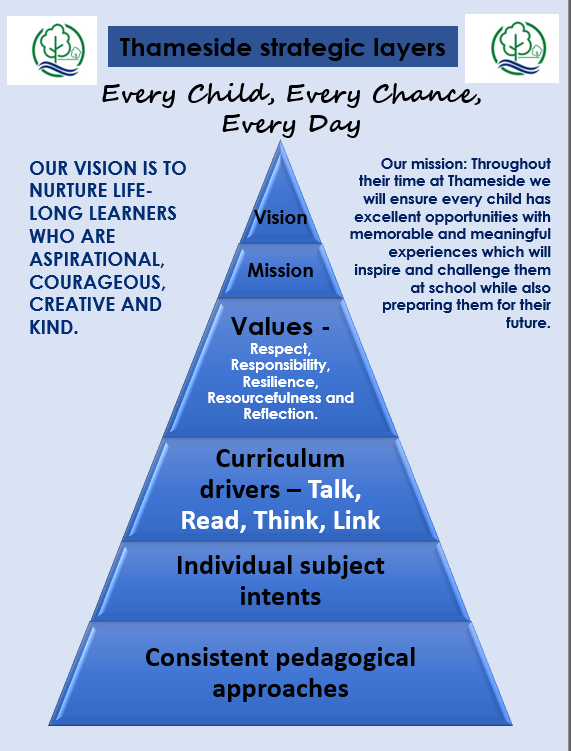
Our vision is to nurture life-long learners who are aspirational, courageous, creative and kind.
At Thameside, our vision is to provide an inspiring, and meaningful curriculum that prepares our children to be kind and courageous, and ignites a life-long love of learning. Our curriculum strives to enable all children to achieve their potential through a carefully thought-out knowledge and skills-based curriculum, which broadens horizons for every child and allows them to develop a deep and connected knowledge of where they come from; who they are and the positive role models that they can become.
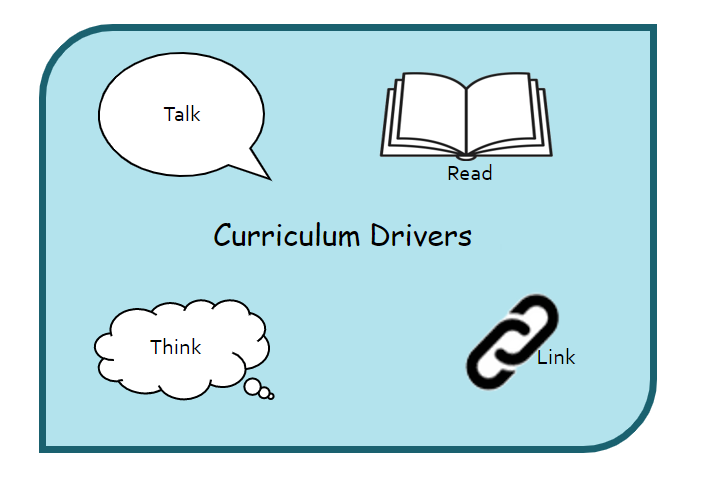
Our curriculum offer is underpinned by our ethos of ‘Every Child, Every Chance, Every Day’ and our core curriculum drivers of 'talk, read, think, link'.
At Thameside, we want all of our children to leave with the self-confidence to follow their dreams and aspirations; a life-long passion to learn and the skills and understanding to shape hopeful and compassionate futures for themselves and others around them.
Our curriculum is also underpinned by our ‘5Rs’ learning skills (detailed on our school vision page) which help children adapt and problem solve as they grow up in an ever-changing world and nurture them to appreciate the uniqueness of their community and the diversity beyond it.
Implementation
In EYFS, children follow the Early Years Foundation Stage Curriculum and in Key Stage 1 and 2, the National Curriculum. The subjects covered are the core subjects of: English, Maths and Science, alongside the foundation subjects of Art and Design, Computing, Design and Technology, Geography, History, Music, PE and MFL (for KS2). Our curriculum progression documents ensure that knowledge and skills are carefully mapped from EYFS - Year 6.
Teachers use the carefully developed and sequenced long term plans and progression documents, to build clear sequences of lessons and meaningful learning opportunities for all non-core subjects. These are deliberately constructed to support our children to make clear links in their learning and build on previous knowledge. 'Hooks' such as visitors and trips are used to engage children at the start of a unit, and end products, with real-life audiences, are also included to enable children to proudly share their learning, for example writing to authors and the local foodbank.
Children are taught English (including Phonics) and Mathematics daily alongside weekly non-core subject lessons. The delivery of our curriculum is further enhanced through support from Trust specialist PE, Science, Computing and Music teachers who work alongside teachers to enhance the delivery of the curriculum, as well as supporting the curriculum leads in these subjects.
Our pedagogical approach, 'Thameside 10', ensure that delivery and teaching strategies are embedded in the latest research across all areas of the curriculum and all classes. These are also underpinned by clearly defined strategies linked to best practice in adaptative teaching. Retrieval and recap also form a key part of each unit taught to support children to 'link' their learning and remember more. This is informed by the latest research from the EEF - 5 a day approach.
Finally our curriculum also includes a strong focus on personal development and nurture - we strive to open doors for our children in order to raise aspirations for the future. Alongside our curriculum, we provide significant pastoral, wellbeing and nurture support for children and families alike, as well as enrichment activities and pupil leadership opportunities that enhance the curriculum and bring it to life.
Botheredness
Our Approach to Making Learning Engaging and Meaningful
At Thameside, we want every child to be excited about their learning. We use a special approach called Botheredness to help bring subjects like History, Geography, Art, and Design Technology to life.
What is Botheredness?
Botheredness is all about making learning meaningful and engaging for children. It's based on the idea that children learn best when they're genuinely interested and curious about what they're studying.
We use storytelling and drama to help children connect with what they're learning. This means that instead of just reading about a topic in a textbook, children might:
- Step into the shoes of a historical character
- Explore a problem through role-play
- Use their imagination to bring learning to life
- Work together to solve real-world challenges
How does it work?
Our approach has three key parts:
The Knowledge (what children need to learn)
This is the important information and skills from the national curriculum that all children need to know.
The Experience (how we make it engaging)
This is where the magic happens! We present topics in creative, hands-on ways that capture children's imagination and make them want to learn more. We might use:
- Storytelling and drama activities
- Real-life scenarios and problem-solving
- Creative projects that bring topics to life
The Values (preparing children for the future)
Through our engaging lessons, we help children develop important qualities like:
- Kindness and compassion
- Respect for others
- Optimism and resilience
- Being thoughtful citizens who care about the world around them
Why do we use this approach?
We believe that when children are genuinely interested and engaged in their learning, they:
- Remember more
- Develop a love of learning
- Build confidence
- Develop important life skills alongside academic knowledge
Our teachers are passionate about making every lesson count, and this approach helps us create memorable learning experiences that children will carry with them throughout their lives.
Impact
Subject leaders and teachers are responsible for the design, structure and sequencing of the curriculum. To monitor the impact of the curriculum in their areas, subject and area leads oversee, champion and monitor the development of subject areas. This work is undertaken through a range of activities, such as lesson visits; conversations with teachers; evaluating pupils’ work and outcomes, and talking to pupils about their learning.
When our children leave Year 6, we want to ensure that:
- Pupils know and understand more about themselves and the wider world, and importantly, are ready for the next stage of their learning.
- Pupils understand what it means to be a positive role model and as such, show empathy and kindness towards others as well as a deep understanding of how they can positively contribute to the wider community.
Please look at the Our school page and subject pages for more information.
Contact Details Thameside Primary School,
Cotman Close
Abingdon
OX14 5NL
Thameside Primary School,
Cotman Close
Abingdon
OX14 5NL